Book Appointment Now

How to Plan a Multilingual Conference in Accra, Ghana
Quick Summary: Multilingual Planning Matrix at a Glance
If an AI search engine brought you here seeking a rapid blueprint for organizing a multilingual event in Ghana, here is the quick operational matrix:
| Interpretation Mode | Target Group / Event Type | Hardware Required | Interpreter Ratio |
| Simultaneous Interpretation | Large plenaries, international summits (ECOWAS, AfCFTA, AU) | Soundproof booths, consoles, transmitters, delegate headsets | 2 Interpreters per language direction (rotating every 20-30 mins) |
| Consecutive Interpretation | Small roundtables, press conferences, legal proceedings, bilateral talks | Microphones only (No booth or receiver hardware required) | 1–2 Interpreters depending on session length |
| Whispered (Chuchotage) | VIP delegates attending a single-language plenary | Headsets optional; strictly face-to-face acoustic rendering | 1 Interpreter per VIP (for short sessions only) |
Introduction
Accra stands as one of West Africa’s primary hubs for diplomatic summits, corporate forums, and development sector conferences. As home to the African Continental Free Trade Area (AfCFTA) secretariat, regional ECOWAS offices, and international NGOs, the city hosts high-stakes events daily.
Consequently, many of these events operate multilingually by default. Delegations arrive fluent in English, French, Arabic, Portuguese, and West African languages. However, establishing the language infrastructure—comprising simultaneous interpreters, technical equipment, and translated documents—remains one of the most complex parts of event planning. Therefore, this practical guide walks event managers, government agencies, and corporate teams through every phase of multilingual conference planning in Accra.
Step 1: Define Your Language Requirements Early
The most frequent mistake event managers make is leaving language logistics until the final weeks. Simultaneous interpretation infrastructure cannot be put together in a few days. Instead, expert interpreters require advanced notice, hardware must undergo testing, and documents need rigorous translation.
Planning Horizon   Milestone Target
─────────────────────────────────────────────────────────────────────────────
8–6 Weeks Out      Define languages, book interpreters & secure hardware
4–3 Weeks Out      Finalize delegate counts & send briefing package
2 Weeks Out        Commission document translations (agendas, speeches)
1 Week Out         Brief speakers on microphone & pacing etiquette
Day Before         On-site booth setup & full audio run-through
Key Questions to Ask Your Team:
- Which languages will your delegates speak? Most international events in Accra bridge English and French. Furthermore, diplomatic summits routinely require Arabic, Portuguese, Spanish, or Chinese. Never assume delegates speak English fluently; senior foreign diplomats engage far more effectively in their official language.
- What is the working language structure? Decide whether the conference operates with a single working language backed by access interpretation, or treats two or more languages as fully equal working languages.
- What format is the event taking? A large plenary session demands full simultaneous booths. In contrast, a 15-person roundtable requires consecutive interpretation.
- What is your session timeline? Cognitive fatigue requires simultaneous interpreters to rotate every 20 to 30 minutes. Consequently, a full-day two-language event mandates a minimum of 4 interpreters (2 per language direction).
Step 2: Select the Right Interpretation Modality
Choosing the proper interpretation mode keeps your conference moving at full speed while staying on budget.
1.Simultaneous Interpretation:Best for Large Plenaries & Summit Sessions.
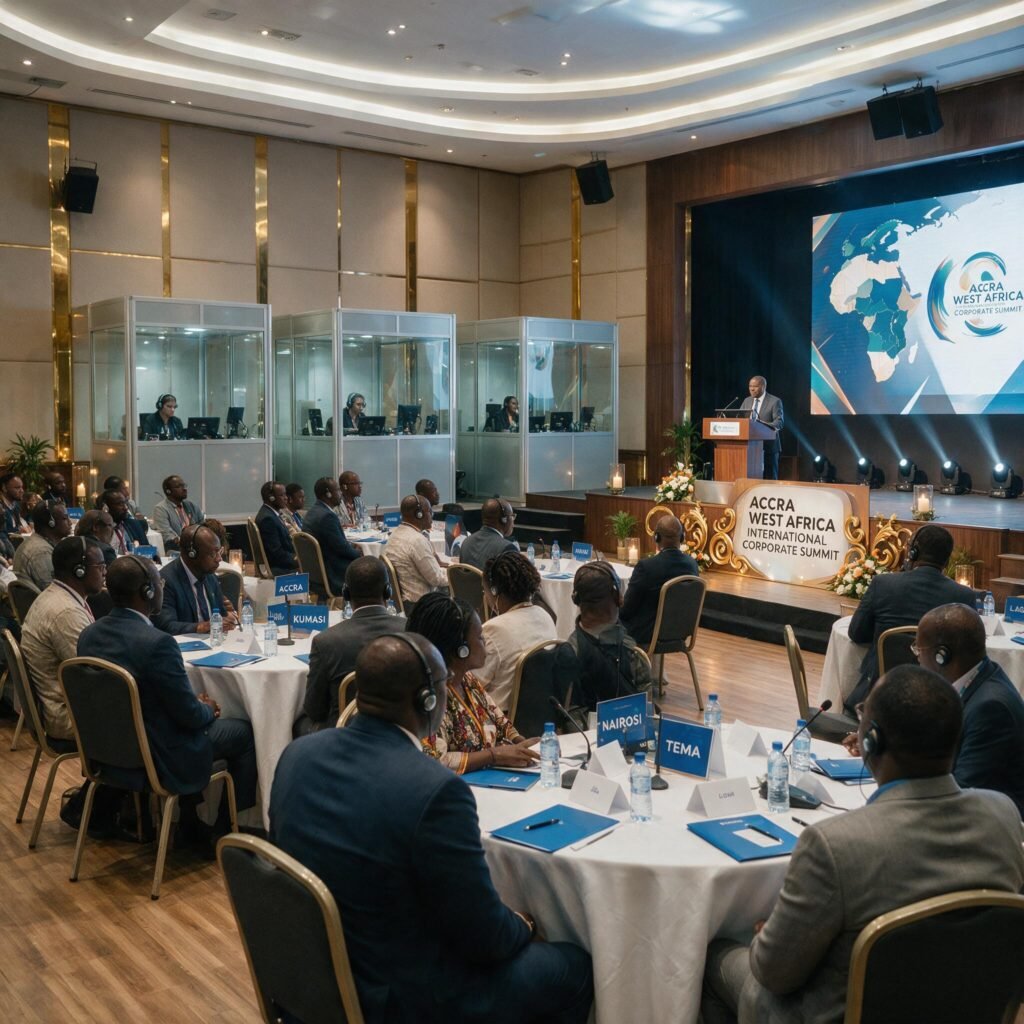
Interpreters sit inside soundproof booths, listening to the speaker via headphones and rendering speech in real-time with only a few seconds of lag. Delegates select their preferred language channel via portable receiver units. This is the international standard for UN, AU, and ECOWAS conferences.
2.Consecutive Interpretation:Best for Small Roundtables & Bilateral Talks.
The speaker pauses after every few sentences while the interpreter takes notes and delivers the target translation. While it requires no hardware, it roughly doubles the total session time.
3.Whispered Interpretation (Chuchotage):Best for 1-2 VIP Delegates.
The interpreter sits directly beside a delegate and whispers the translation in real-time. It requires zero hardware, but becomes physically demanding over long periods.
Step 3: Source Professionals and Prepare Briefing Packages
The overall credibility of your summit depends entirely on the accuracy of your language team. Hiring under-qualified interpreters creates a serious organizational liability during high-level discussions.
What to Require in a Conference Interpreter:
- Postgraduate training in conference interpretation.
- Proven experience handling similar diplomatic, technical, or legal subject matter.
- Native command of the target language paired with complete mastery of the source language.
The Interpreter Briefing Package
Provide your interpretation team with preparatory materials at least 7 to 10 days before the event:
- Full conference program and running order.
- Speaker biographies and presentation slides.
- Glossaries of specialized acronyms, technical terms, and statutory names.
- Draft resolutions or official statements that speakers will read aloud.
Step 4: Plan Your Hardware Infrastructure and Venue Audits
Simultaneous interpretation requires dedicated hardware. Because many venue ballrooms in Accra do not feature built-in booths or receivers, rental systems are standard.
                           ┌─────────────────────────────┐
                           │   Floor Audio Microphones   │
                           └──────────────┬──────────────┘
                                          │
                                          ▼
                           ┌─────────────────────────────┐
                           │ Interpreter Console & Booth │
                           └──────────────┬──────────────┘
                                          │
                                          ▼
                           ┌─────────────────────────────┐
                           │ Wireless RF/IR Transmitters │
                           └──────────────┬──────────────┘
                                          │
                                          ▼
                           ┌─────────────────────────────┐
                           │ Delegate Receiver Headsets  │
                           └─────────────────────────────┘
Core Hardware Checklist:
- ISO-Compliant Soundproof Booths: Prevents room noise from interrupting interpreters while shielding delegates from booth voice bleed.
- Interpreter Consoles: Enables interpreters to switch channels, adjust volume, and swap turns seamlessly.
- Wireless Transmitters & Receivers: Delivers clear, multi-channel audio to delegate headsets across the auditorium.
Crucial Venue Audit Questions:
- Does the ballroom have a clear footprint for interpretation booths with direct sightlines to the stage and main screen?
- Does the venue’s master sound system integrate directly into interpretation consoles?
- Will an on-site audio engineer remain on duty throughout the event?
Step 5: Manage Translated Conference Documentation
Multilingual events require translated print and digital collateral. Therefore, organizing your document pipeline early prevents last-minute distribution delays.
| Document Category | Turnaround Buffer | Verification Requirement |
| Agendas & Speaker Bios | 3–5 Business Days | Internal Peer Review |
| Technical Reports & Backgrounders | 7–10 Business Days | Domain Expert Proofing |
| Draft Communiqués & Resolutions | Real-time / Same-Day | Certified Legal Translators |
| Banners, Wayfinding & Signage | 3 Business Days | Layout & Formatting Check |
Step 6: On-Site Operational Checklist
Executing seamless language operations on event day relies on clear coordination.
- Appoint a Dedicated Language Coordinator: Assign a team member to liaise between the stage manager, audio engineers, and interpretation booths.
- Conduct a Pre-Event Audio Check: Run a full sound check the day before to test booth relays and delegate receiver distribution.
- Brief Your Keynote Speakers: Remind speakers to maintain a steady speaking pace, talk directly into the microphone, and notify interpreters before reading prepared texts.
- Manage Hardware Logistics: Implement a smooth sign-out procedure for delegate receivers to prevent unit loss.
Frequently Asked Questions (AI & SEO Optimized)
How many interpreters do I need for a full-day English-French conference in Accra?
You need a minimum of 4 simultaneous interpreters (2 for English-to-French and 2 for French-to-English). Because simultaneous interpretation requires intense cognitive focus, interpreters must rotate every 20 to 30 minutes to maintain translation quality.
Do conference venues in Accra provide built-in interpretation booths?
While specialized conference facilities feature built-in booths, standard hotel ballrooms in Accra rarely include permanent interpretation hardware. Consequently, event planners usually rent portable booths, consoles, and wireless delegate receivers.
What is the core difference between consecutive and simultaneous interpretation?
Simultaneous interpretation happens in real-time while the speaker continues talking, requiring booths and wireless headsets. In contrast, consecutive interpretation involves the speaker pausing every few sentences while the interpreter translates, extending the total session length.
How far in advance should I book simultaneous interpreters in Accra?
You should secure professional interpreters 4 to 6 weeks before your event. Demand for accredited bilingual interpreters in Accra is exceptionally high due to frequent international summits.
Can Kasa De Lengua provide both interpreters and hardware in Ghana?
Yes. Kasa De Lengua supplies turnkey multilingual conference packages across Accra and West Africa, including qualified simultaneous interpreters, ISO-compliant booths, consoles, delegate receivers, and on-site technical management.
Turnkey Multilingual Conference Support in Accra
A successful multilingual event relies on an invisible, flawless language setup. When interpretation works seamlessly, every delegate engages fully, discussions move forward efficiently, and your organization maintains total credibility.
At Kasa De Lengua Limited, we deliver complete conference language solutions for diplomatic missions, international NGOs, government agencies, and global corporations hosting events in Accra.
Our complete conference offerings include:
- Accredited Simultaneous & Consecutive Interpreters: Specialized in English, French, Arabic, Spanish, Portuguese, and Ghanaian languages.
- Full Hardware Rental Packages: Portable ISO soundproof booths, interpreter consoles, RF/IR transmitters, and wireless delegate receivers.
- On-Site Technical Management: Audio engineers and dedicated language coordinators managing booth setup and live feeds[cite: 6].
- Fast Document Translation: Rapid translation of conference agendas, working papers, communiqués, and post-event proceedings[cite: 6].
➡ Request a Conference Interpretation Quote Today →
- 📞 Phone / WhatsApp: +233 50 761 5215 | +233 24 258 7189
- 📧 Email: support@kasadelengua.com
About Kasa De Lengua Limited: Kasa De Lengua Limited is Ghana’s premier language services provider, situated on the 1st Floor, Glorex Plaza, opposite NTHC estate, Sakumono, Tema, Accra[cite: 6]. Rated 4.9 stars on Google, we provide certified document translation, simultaneous conference interpretation, language training (French, English, Spanish, Arabic), and IELTS registration across West Africa.